

Mid-February in Montreal is a unique kind of test. The initial excitement of the first snowfall has long since faded, replaced by the reality of “The Grind”—that endless cycle of slush, salt, and freezing rain. By now, your boots have been on the front lines for about two months.
To the untrained eye, a bit of dirt and a few white salt lines are just part of the winter uniform. But as master cobblers, we know that mid-February is the “breaking point.” This is the moment when a small, fixable issue turns into a permanent, “trash-bin-bound” disaster.
At Cordonnerie Rockland, our workshop is currently bustling with Montrealers who waited until their feet were soaking wet to visit us. To save you from a mid-commute catastrophe, we’ve put together this mid-season check-up guide. If your boots show any of these three signs, they won’t make it to April without professional intervention.
View this post on Instagram
”Always very friendly, fast and above all, high-end service.
Nadine PaquinCustomer
Our mission: offer quality and durable repairs
Whatever the repair is needed, our team will always make sure to make the best recommendation. We will take the time to inform and help you make a decision. Our goal? To offer a well-made result that will stand the test of time, because we know how precious your favourite shoes or boots are on a daily basis. Our services will extend the life of your favourite accessories!
1. The “Soft Spot” Test: Checking for Thinning Soles
Most people don’t look at the bottom of their boots until they feel a puddle. By then, it’s often too late to do a simple “sole protector” or a “half-sole.” You’re looking at a full, expensive reconstruction.
How to Check:
Turn your boots over. Press your thumb firmly into the center of the sole (the ball of the foot).
- The Sign of Failure: Does the rubber feel “mushy” or thin? Can you feel the internal structure of the boot through the sole? If there is a visible “divot” or if the tread has completely disappeared in that one spot, your boot is effectively a sponge.
- The Risk: Once the outer sole is compromised, moisture reaches the internal “filler” (usually cork or foam) and the leather insole. Once those get wet, they begin to rot from the inside out, often leading to that persistent “old boot smell” that never goes away.
The Cordonnerie Rockland Solution: If caught early, we can apply a Vibram protective layer. If the “Soft Spot” is already a hole, we perform a full resole, replacing the failing material with high-grade Italian rubber designed to outlast the original factory specs.
2. The “Open Mouth”: Delamination and Seam Failure
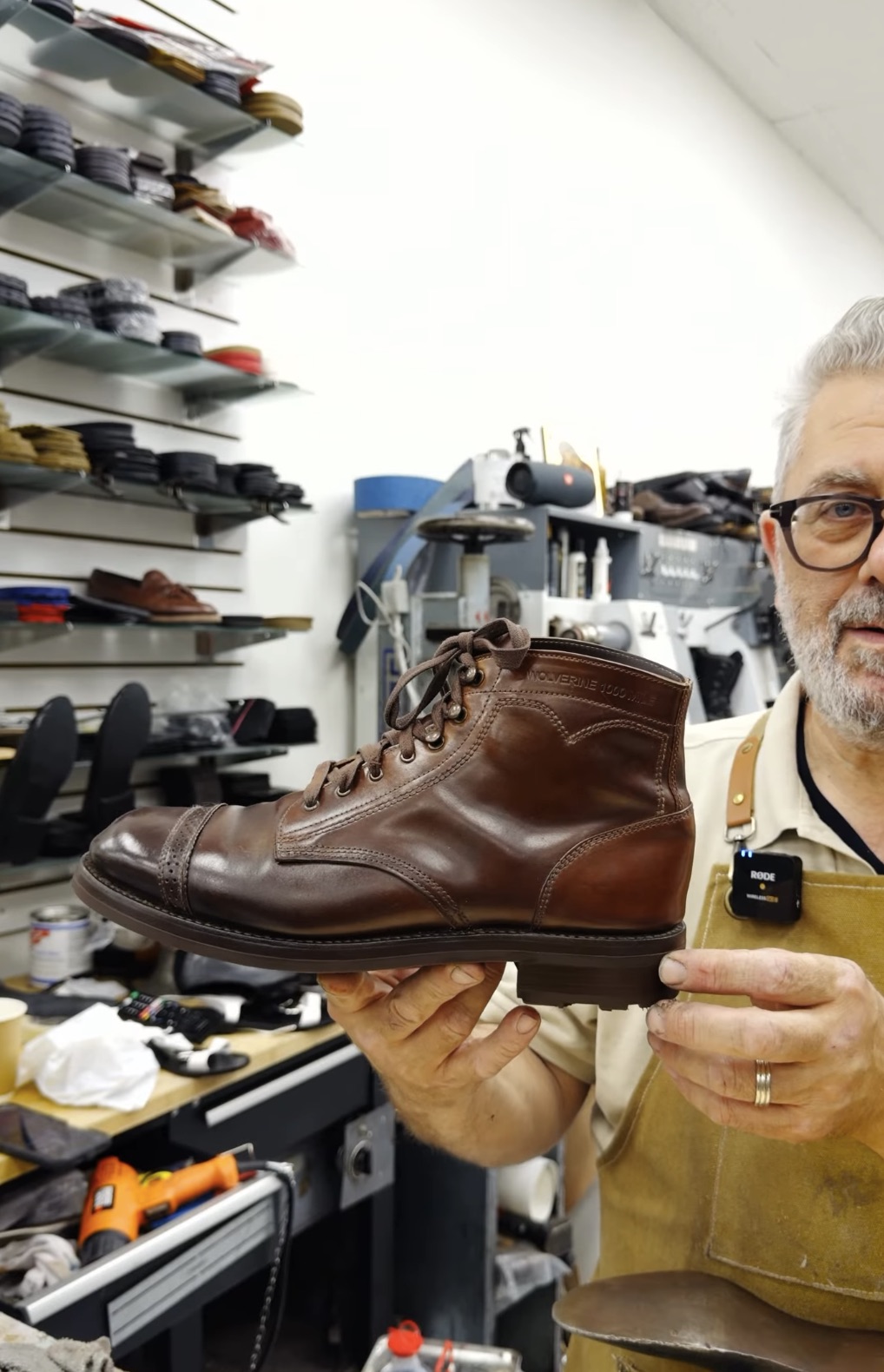
Montreal’s road salt is a master at finding the weakest link in your footwear: the adhesive bond. Whether your boots are $1,000 designer pieces or rugged heritage workboots, they are held together by a combination of stitching and industrial-grade cements.
How to Check:
Inspect the area where the leather “upper” meets the sole. Flex the boot as if you were taking a step.
- The Sign of Failure: Do you see a small gap opening up? Is the sole starting to “peel” away at the toe or the heel?
- The Chemistry of the Gap: Road salt acts as a corrosive agent. When salty slush gets into those tiny gaps, it doesn’t just sit there. It eats away at the glue and dries out the stitching. Once the “seal” is broken, every step you take acts like a pump, drawing more salt and grit deeper into the structure of the shoe.
The Cordonnerie Rockland Solution: We don’t just “squirt some glue” in the gap. We professionally clean the area to remove all salt residue, “rough up” the surfaces to ensure a mechanical bond, and use heat-activated industrial cements to fuse the boot back together.
View this post on Instagram
3. The “Salt Burn”: Stiffness at the Flex Point
This is the most “silent” killer of boots. Leather is a skin composed of complex protein fibers. It is designed to be flexible. However, when salt penetrates those fibers, it undergoes a chemical reaction that turns the leather into something more like cardboard.
How to Check:
Look at the “flex point”—the area across the top of your toes where the boot bends when you walk.
- The Sign of Failure: Does the leather feel stiff and “crunchy” to the touch? Do you see deep, white-rimmed cracks forming in the creases? Does the leather look “puckered” or bubbly?
- The Point of No Return: Once leather actually cracks all the way through at the flex point, it is nearly impossible to fix invisibly. You are left with a permanent hole that lets in water.
The Rockland Solution: We use a professional Neutralization and Re-Hydration process. We use chemical neutralizers to pull the salt out of the pores, followed by deep-tissue conditioners that penetrate the leather to restore its elasticity.
Frequently Asked Questions (FAQ)
I waterproofed my boots in November. Aren't I safe?
Unfortunately, no. Waterproofing sprays are sacrificial coatings. Between snow friction and salt, most sprays wear off after 4 to 6 weeks. Mid-February is exactly when your November protection has evaporated.
Can I just use a salt-remover wipe from the drugstore?
Wipes are great for a surface clean, but they don’t reach the “root”—the salt trapped inside the leather fibers or underneath the sole bond. A professional deep-clean is a structural necessity.
Why should I bring them to a cobbler instead of just buying a new pair on sale?
Most “end of season” sales are for lower-quality fashion boots. If you have a high-quality pair that fits perfectly, restoring them is the better move. You keep the comfort you’ve already “earned” and get a boot that is often tougher than it was brand new.
How long is the wait time right now?
Because mid-February is the peak of the “Winter Crisis” in Montreal, our workshop is currently operating at maximum capacity. We take immense pride in our work and refuse to cut corners, especially with curing times for adhesives. Please contact us for our latest timelines. Thanks!